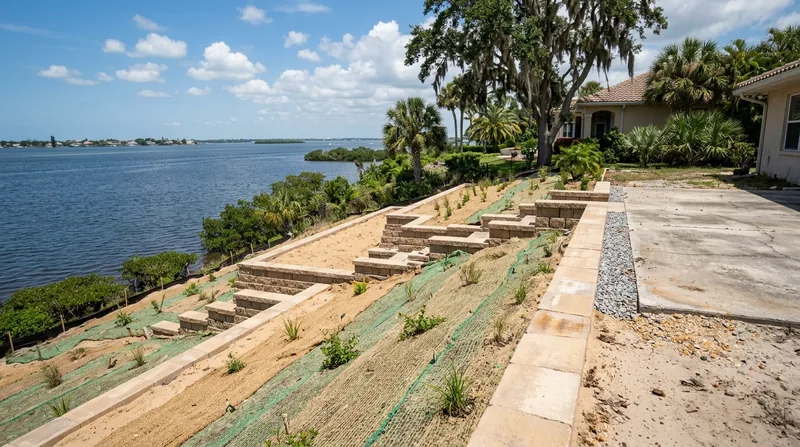




Slope Stabilization & Erosion Control in St. Petersburg: Holding Your Ground on Sandy Pinellas Soil
St. Petersburg sits on the low sandy Pinellas peninsula, mostly flat ground only a few feet to a few dozen feet above sea level, and that flatness is exactly why Slope Stabilization & Erosion Control in St. Petersburg matters more than most homeowners expect. Fine sandy soil washes out through open joints, the water table sits high, and summer downpours plus hurricane storm surge strip bare dirt fast. The real slopes here are specific: the Booker Creek ravine in Historic Roser Park, the higher ridge through Crescent Heights and Allendale, and the bluffs of Dunedin and Belleair over Clearwater Harbor. When a bank starts sliding, it takes pool decks, driveways, and foundation grades with it. We build terraced walls, geogrid reinforcement, and drainage that keep your dirt where it belongs. If a slope has already moved, start with leaning and collapsed wall repair before the damage spreads.
Why Erosion Control Matters on the St. Petersburg Peninsula
The dominant failure mode in this city is sandy soil washing out from under a wall after a hard summer storm. St. Petersburg gets towering thunderheads from June through September, and a single afternoon can dump two inches on a lot that drains toward a ravine, a seawall, or a neighbor's grade. Add the fill pads raised after Hurricanes Helene and Milton in 2024, and you have fresh, uncompacted slopes that move the first wet season.
- Sandy Pinellas soil migrates through open block joints and undermines footings from behind.
- High water table saturates backfill and pushes walls forward during the rainy season.
- New fill pads on raised lots in Shore Acres and Coquina Key settle and slump without reinforcement.
- Storm surge and runoff strip topsoil off waterfront grades on Snell Isle and Venetian Isles.
- Rotted timber and railroad tie walls release their soil load and fail suddenly.
Every one of these problems gets cheaper to fix the season you notice it, not the season it collapses.
Key info: On the Booker Creek ravine in Historic Roser Park, a 1910s bungalow lost six feet of backyard bank in one summer of storms. A terraced segmental wall with geogrid and a drainage chimney stopped the movement and saved the rear porch footing.
The Florida Department of Environmental Protection publishes guidance on stormwater and erosion control that is worth a read before any grading project on your lot.
How We Stabilize a Slope in St. Petersburg, Step by Step
We start by reading the water, not the wall. On a St. Petersburg lot, the question is where storm runoff goes, how high the water table sits in the wet season, and what the soil actually is under the grass. Then we build the fix around those answers, using segmental block, geogrid, and drainage rather than a cosmetic face that fails in two years.
- We walk the slope and mark the failure lines, wet spots, and any cracking in existing walls or pool decks.
- We check the property line and setback rules with the local building department before we design anything.
- We excavate to stable soil and bench the slope in terraces instead of one tall face.
- We lay geogrid reinforcement in lifts behind each course so the wall acts as one mass with the hillside.
- We install a drainage chimney with gravel, filter fabric, and outlet pipe to move water away from the wall.
- We finish the surface with vegetation or capstone that sheds runoff instead of trapping it.
That sequence is what separates a stabilized slope from a wall that just looks stable for one season.
Key info: On a Dunedin bluff lot above Clearwater Harbor, we terraced a 9 foot drop in three benches with geogrid and a drainage chimney. The pool deck above had been creeping toward the edge for two years; it has not moved since.
If your slope drains toward a wall, the fix is only as good as the water management. Read our retaining wall drainage page before you approve any design.
Slope Stabilization Methods We Use on Pinellas County Ground
Not every slope needs the same approach. A ravine bank in Roser Park behaves nothing like a fill pad in Shore Acres or a bluff in Belleair, and the method should follow the soil, the height, and what sits on top of the slope.
| Approach | Description | Best for |
|---|---|---|
| Terraced segmental block with geogrid | Two or more stepped walls with reinforcement layers tying each course back into the hillside. | Ravine banks and raised lots where height must be broken up. |
| Boulder and natural stone toe | Heavy limestone or coquina placed at the base to absorb wave and runoff energy. | Waterfront grades and shorelines exposed to surge. |
| Drainage chimney and surface swale | Gravel column, filter fabric, and graded swale that route water away from the wall. | Any slope where saturation drives the movement. |
| Vegetative and erosion blanket cover | Deep rooted native planting and matting that hold topsoil until roots take over. | Low banks and the face above a structural wall. |
| Poured concrete or CMU face | Rigid wall for tight property lines where block footprint will not fit. | Narrow lots and walls carrying a driveway or structure surcharge. |
We pick the method after we see the water path and the soil, not before.
Slope Stabilization & Erosion Control Cost in St. Petersburg: What to Expect
Every job starts with a free estimate, and that on-site visit is where the real number comes from. Slope work is priced by the linear foot of wall, the height and number of terraces, the amount of excavation, and how tight the access is. A ravine bank behind a Kenwood bungalow with a fence and a shed in the way costs more to stabilize than an open side yard in Pinellas Park.
Expect the price to climb with wall height above four feet, with engineered drawings if the wall carries a surcharge, and with any dewatering needed because the water table is high. Getting two or three estimates is smart here because the scope can be read very differently from one contractor to the next. Our full pricing overview breaks down what drives the number.
Hiring a Retaining Wall Contractor Near Me in St. Petersburg: What to Check
Slope work is structural work, and the contractor you pick should be able to explain the drainage plan before they talk about price. Ask for proof of insurance, ask for references on jobs like yours, and ask who pulls the permit. In St. Petersburg, walls above roughly four feet from the footing, or walls supporting a driveway or structure, usually need a permit, so verify the threshold with the local building department. If your lot sits in a historic district like the Old Northeast or Roser Park, check design review rules before you sign anything.
We are fully insured and hold NCMA Segmental Retaining Wall Installer Certification. You can reach us through our contact page to schedule a free estimate, and we will tell you plainly whether your slope needs a structural fix or just better drainage.
Slope Stabilization & Erosion Control in St. Petersburg: Pricing Guide
| Service | Price | Details |
|---|---|---|
| Free on-site estimate | Free | Full slope walk, drainage read, and written scope before any number is quoted. |
| Erosion control and drainage only | Starting at $1,800 | Swale, drainage chimney, and surface cover; rises with run length and access. |
| Terraced segmental wall stabilization | Starting at $55 per sq ft of wall face | Includes geogrid, gravel backfill, and drainage; height and terrace count move the price. |
| Bluff or ravine engineered stabilization | On estimate | Needs on-site review and possibly engineered drawings before pricing is possible. |
| Travel | Included | in St. Petersburg and surrounding areas, no separate call-out or mileage fee |
| Estimate | Free | Response within 24h at (727) 295-2091, no obligation to book |
Indicative pricing, the exact cost depends on square footage, finish, and site access. Free personalized estimate within 24h at (727) 295-2091.


