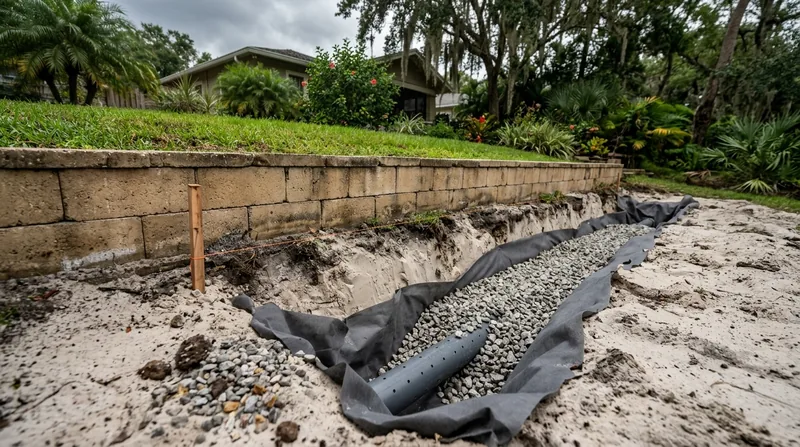




Retaining Wall Drainage in St. Petersburg: Why Your Wall Fails Without It
Proper Retaining Wall Drainage in St. Petersburg is the difference between a wall that stands for decades and one that leans, cracks, or collapses after a single summer. Our city sits on the low sandy Pinellas peninsula between Tampa Bay and the Gulf, mostly flat ground just a few feet above sea level with a high water table underneath. Fine Florida sand washes out through open joints, and summer downpours dump inches in an hour. When water builds up behind a wall and has nowhere to go, hydrostatic pressure pushes it over, and fine sand migrates out until the footing loses support. That is the leading cause of retaining wall failure here, not bad block. We build drainage systems that relieve that pressure and keep the sand where it belongs. If your wall is already showing the damage, start with retaining wall repair before the lean turns into a collapse.
Why Drainage Decides Whether a St. Petersburg Wall Survives
St. Petersburg gets hit from both directions. Summer thunderheads soak the ground, then the water table rises in low areas like Shore Acres and Coquina Key. On the rare real slopes, such as the Booker Creek ravine in Historic Roser Park or the bluffs of Dunedin and Belleair over Clearwater Harbor, that water runs downhill and piles up behind walls. Add hurricane storm surge from Helene and Milton and the new fill-raised lots, and drainage stops being optional. Here is what we see fail most:
- Segmental block walls built with no gravel backfill trap water until the blocks bulge and shift.
- Timber and railroad tie walls rot from trapped moisture and termites long before the wood looks bad from the street.
- Poured concrete and CMU walls at property lines crack when hydrostatic pressure has no weep holes to escape through.
- Fine sandy soil washes out through open joints and leaves voids under the footing.
- Pool deck and driveway grades push surcharge loads onto walls that were never drained for it.
Every one of these failures traces back to water that could not get out. A drained wall handles the same storm that destroys an undrained one.
Key info: In the Old Northeast and Kenwood, we routinely find 1920s garden walls with no drainage at all. The soil behind them is saturated sand, and one heavy July storm is enough to push a leaning wall past the point of repair. If your wall sits on a raised lot in Snell Isle or Venetian Isles, check the backfill before hurricane season.
For official guidance on when a wall needs a permit or engineered drawings, check the City of St. Petersburg building department at stpete.org. Thresholds vary, and walls above roughly 4 feet from the footing, or walls carrying a driveway or structure surcharge, usually need a closer look.
How We Build Drainage Behind a St. Petersburg Wall
We do not guess at drainage. We open the wall, look at what the water is actually doing, and build a system that moves it out and away. The sandy soil here makes filter fabric and clean gravel non-negotiable, because without them the drain clogs with fines in a season or two. Here is the process we follow on a typical job:
- We excavate behind the wall to expose the backfill and find where water is pooling.
- We install a perforated French drain at the footing, wrapped in filter fabric and bedded in washed gravel.
- We cut weep holes through block and concrete walls at regular spacing so pressure never builds.
- We backfill with clean gravel and fabric so fine sand cannot wash into the drain.
- We daylight the drain to a safe outlet, a swale, a pop-up emitter, or a storm line, so it actually discharges.
- We rebuild the wall face and grade the surface so runoff flows away from the wall, not into it.
On a Crescent Heights wall holding a driveway grade, that outlet location matters as much as the drain itself. Water that dumps onto a neighbor's lot or back into the same soil solves nothing.
Key info: A homeowner in Gulfport had a segmental block wall holding a raised front yard. It had bulged six inches after two wet summers. We pulled the face, found the original builder had backfilled with native sand and no drain at all. A French drain, gravel, fabric, and weep holes brought the wall back to plumb, and it has held through every storm since.
If the wall is already past draining and needs rebuilding, see our block and segmental retaining walls page for how we build them right the first time.
Drainage Approaches We Use on St. Petersburg Walls
Not every wall needs the same system. A garden wall in Seminole and a tall wall on a Dunedin bluff have different water loads, and we match the approach to the site. The table below shows the main options and where each one fits.
| Approach | Description | Best for |
|---|---|---|
| French drain at the footing | Perforated pipe in washed gravel, wrapped in filter fabric, daylighted to an outlet. | Segmental block and CMU walls holding raised lots. |
| Weep holes and gravel backfill | Spaced holes through the wall face with gravel and fabric behind to release pressure. | Poured concrete and CMU walls at property lines. |
| Surface grading and swales | Regrading the ground above the wall so runoff flows away instead of into the backfill. | Pool decks, driveway grades, and low flat lots. |
| Chimney drain in gravel | A vertical column of clean gravel and fabric that carries water down to the footing drain. | Tall walls and slopes with heavy groundwater. |
| Drainage retrofit on an existing wall | Opening the wall, adding drain and fabric, and rebuilding the face without full replacement. | Walls that are bulging but not yet collapsed. |
We match the system to the wall and the water load, not to a one-size template. That is how a drainage fix lasts through a Florida wet season.
Retaining Wall Drainage Cost in St. Petersburg: What to Expect
Drainage work starts at From $2,500 for a straightforward retrofit on a single wall, and that figure covers the common case: excavating behind the wall, installing a French drain and weep holes, gravel and filter fabric backfill, and daylighting the outlet. Real jobs move up or down from there based on a few concrete factors. Our full pricing overview breaks down the ranges in detail.
- Wall length and height drive the amount of drain pipe, gravel, and labor involved.
- Access matters, and a wall behind a pool cage on Snell Isle takes more handling than one at the curb.
- Outlet location can add cost if the drain has to run a long distance to a storm line or swale.
- Existing damage raises the price, because a bulging wall may need partial rebuild along with the drain.
- Material type affects labor, since cutting weep holes through poured concrete takes more work than block.
Get two or three estimates and compare what is actually included, not just the bottom line. A cheap quote that skips the filter fabric or the outlet will cost you again in two years.
Retaining Wall Drainage Near Me: How to Vet a Contractor in the St. Petersburg Area
When you search for retaining wall drainage near me, the results all sound alike. The differences show up in the details. Ask each contractor the same questions and compare the answers, not the sales pitch. We are fully insured, and we will show you a certificate on request.
- Confirm insurance coverage and ask for a certificate before any work starts.
- Get at least three written estimates that spell out the drain type, materials, and outlet.
- Ask for local references on walls similar to yours, in block, concrete, or timber.
- Check whether a permit or engineered drawing is required for your wall height and surcharge.
- Ask how the contractor will protect palms, live oaks, and landscaping during excavation.
- Confirm whether any HOA rules apply to wall work or drainage discharge on your lot.
We are NCMA Segmental Retaining Wall Installer Certified, and we build drainage to the same standard we build walls. Reach out through our contact page for a free estimate and a straight answer on what your wall needs.
Retaining Wall Drainage in St. Petersburg: Pricing Guide
| Service | Price | Details |
|---|---|---|
| Drainage retrofit, single wall | Starting at $2,500 | Includes French drain, weep holes, gravel and fabric backfill, and daylighted outlet for a typical wall. |
| Full drainage system on a tall or tiered wall | Starting at $4,200 | Adds chimney drains and longer outlet runs; wall height and groundwater load move the price. |
| Drainage plus partial wall rebuild | On estimate | Bulging or cracked walls need an on-site look before we can price the rebuild and drain together. |
| Travel | Included | In St. Petersburg and surrounding areas, no separate call-out or mileage fee. |
| Estimate | Free | Response within 24h at (727) 295-2091, no obligation to book. |
Indicative pricing, the exact cost depends on square footage, finish, and site access. Free personalized estimate within 24h at (727) 295-2091.


