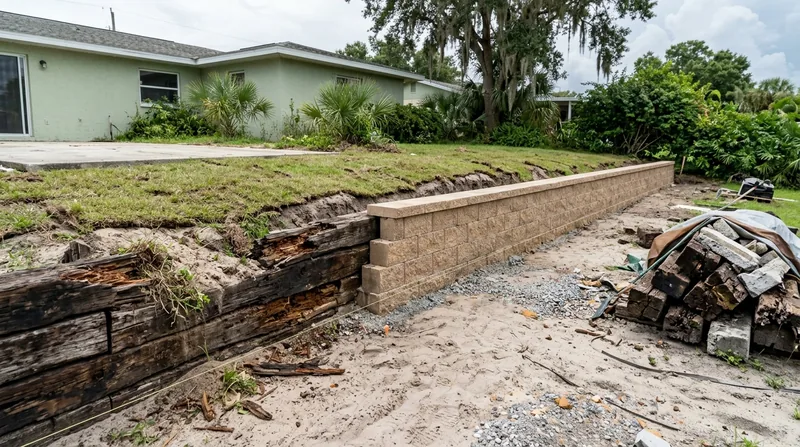




St. Petersburg sits on the low sandy Pinellas peninsula, and most of this city is only a few feet above sea level. That flat ground is exactly why so many 1980s and 90s railroad tie walls went in to hold a raised lot, a driveway grade, or a pool deck. Forty years of subtropical sun, summer downpours, and termites have turned many of those creosote ties into rotting, leaning, insect-riddled timber that no longer holds soil. Railroad Tie Wall Replacement in St. Petersburg means pulling the old ties out, hauling the creosote-soaked wood away, and rebuilding the wall in block, concrete, or natural limestone so it drains and stays put. We handle the demolition, the new gravel backfill and drainage, and the rebuild. If your tie wall is already leaning or collapsing, start with leaning and collapsed wall repair before the grade gives way.
Why Railroad Tie Walls Across St. Petersburg Are Failing Now
Creosote ties were the cheap answer in 1985, and they held up for a while. In St. Petersburg's heat and humidity they do not last four decades. Termites bore through the wood, the creosote leaches out, and the sandy Pinellas soil washes through the open joints every time a summer thunderstorm dumps two inches in an hour. You see it in Kenwood, Old Southeast, and the 1950s block ranches of Shore Acres: a tie wall that has settled, twisted, and started to bulge.
- Termites and dry rot hollow out the ties from the inside while the face still looks intact.
- Fine sandy soil washes out through open tie joints and leaves voids behind the wall.
- The high water table keeps the lower courses wet, which speeds decay and pushes the wall out.
- Hurricane storm surge and summer downpours saturate the backfill and add load the old ties cannot carry.
- Creosote is a regulated preservative, so demolition and haul-away need proper handling, not a dumpster on the curb.
Every one of those failure modes is common in St. Petersburg, and each one gets worse with another wet season.
Key info: A tie wall on a Snell Isle or Venetian Isles lot that holds a raised pool deck is carrying a surcharge, not just soil. Pinellas County and the City of St. Petersburg building departments can require a permit and engineered drawings once a wall passes roughly 4 feet from the footing or supports a driveway or structure. Verify the current threshold with the city before you schedule demolition.
For the official rules, check the City of St. Petersburg construction permitting pages at stpete.org before any tie wall comes down.
How We Replace a Railroad Tie Wall in St. Petersburg, Step by Step
We do not stack new block in front of old rot. The old wall comes out first, all of it, ties, stakes, and failed backfill. Then we rebuild the drainage and the wall so the new structure handles St. Petersburg's sandy soil and high water table. Here is the sequence we run on a typical job.
- We walk the wall and mark the property line, the grade, and any utilities before anything moves.
- We pull the creosote ties, cut them to haul size, and load them out for proper disposal.
- We excavate to the footing depth the new wall needs and compact the base.
- We install gravel backfill, filter fabric, and a perforated drain pipe that outlets daylight, not into the neighbor's yard.
- We build the new wall in segmental block, poured concrete, or natural limestone, compacting lift by lift.
- We cap, backfill, and restore the grade and lawn.
That order matters in St. Petersburg because skipping the drainage step is how a brand-new wall leans within two wet seasons.
Key info: On a Crescent Heights lot we replaced a 38-foot tie wall that had rotted through and was pushing into a driveway. The new segmental block wall went in with a gravel chimney drain and a daylight outlet, and the driveway grade stayed where the homeowner needed it. That is a typical St. Petersburg job, not an exception.
If the grade behind the wall is steep or the soil is moving, we fold in slope stabilization and erosion control so the wall is not fighting the hillside alone.
Replacement Approaches We Use in St. Petersburg
Not every tie wall should be rebuilt the same way. The right choice depends on how tall the wall is, what it holds up, and how much room you have behind it. These are the four approaches we use most on Pinellas County properties.
| Approach | Description | Best for |
|---|---|---|
| Segmental block replacement | Old ties out, engineered block in, with gravel backfill and drain pipe. | Most residential tie walls up to 4 to 5 feet. |
| Poured concrete replacement | Formed and poured wall with weep holes and footing. | Property-line walls and walls that hold a structure. |
| Natural limestone rebuild | Florida limestone or coquina laid with proper batter and drainage. | Garden walls and visible landscape walls. |
| Tie wall to tiered block | Two or three stepped block walls with benches between them. | Taller grades where a single wall would need engineering. |
| Timber-to-tie swap with drainage | New treated timber wall with gravel and drain, where timber fits the look. | Low garden walls under 3 feet. |
We size the approach to the load, the soil, and the permit threshold, not to what is fastest to sell.
Railroad Tie Wall Replacement Cost in St. Petersburg: What to Expect
Most tie wall replacements in St. Petersburg start around $35 per square foot of wall face, and that figure moves with the wall. A 2-foot garden wall in Gulfport is a different job from a 5-foot wall holding a raised driveway in Allendale. The number you get should reflect the demolition, the haul-away of creosote wood, the new drainage, and the finished wall, not just the block.
- Wall height and total square footage drive the base number more than anything else.
- Access matters: a wall behind a pool cage or tight side yard takes longer to demo and rebuild.
- Creosote tie disposal adds cost because the wood needs proper handling, not a standard debris box.
- Drainage scope (drain pipe, gravel, outlet) is priced in, and skipping it is a false savings.
- Permit and engineering requirements add cost when the wall is tall or holds a surcharge.
Get two or three written estimates and compare what each one includes, especially the drainage and disposal line items. Our full breakdown lives on the pricing page, and we will walk your wall and give you a real number.
Hiring a Retaining Wall Contractor Near St. Petersburg: What to Check
Replacing a tie wall is demolition plus structural work, so the contractor you pick matters more than the block color. Ask direct questions and expect direct answers. A crew that cannot explain its drainage plan or its disposal method is not the crew for a creosote tie job.
- Confirm the company carries liability and workers' compensation coverage, and ask for a certificate.
- Get at least two or three written estimates that itemize demolition, drainage, and disposal.
- Ask for recent references on tie wall replacements in St. Petersburg, not just new installations.
- Ask who pulls the permit if your wall is over the city threshold or holds a driveway or structure.
- Check HOA rules in your subdivision before demolition day, especially in planned communities.
We are fully insured and hold NCMA Segmental Retaining Wall Installer Certification, and we will show you the paperwork. Reach out through the contact page to set up a walk-through.
If you want to see how a rebuilt wall should look and drain, review our block and segmental retaining walls work before you commit.
Railroad Tie Wall Replacement in St. Petersburg: Pricing Guide
| Service | Price | Details |
|---|---|---|
| Tie wall replacement, block | Starting at $35/sq ft | Includes tie demolition, creosote haul-away, gravel backfill, drain pipe, and new segmental block wall. |
| Tie wall replacement, concrete | Starting at $48/sq ft | Includes forming, pour, weep holes, footing, and disposal, priced higher for walls holding a structure. |
| Tie wall replacement, limestone | Starting at $55/sq ft | Includes Florida limestone or coquina laid with batter, drainage, and a finished cap. |
| Tiered or engineered rebuild | On estimate | Tall or surcharge walls need an on-site look, soil review, and possibly engineered drawings before pricing. |
| Creosote tie disposal | Included | Proper handling and haul-away of treated ties is built into every replacement quote, no surprise line item. |
| Estimate | Free | On-site walk and written quote within 24 hours at (727) 295-2091, no obligation to book. |
Indicative pricing, the exact cost depends on square footage, finish, and site access. Free personalized estimate within 24h at (727) 295-2091.


